
Drones as Infrastructure
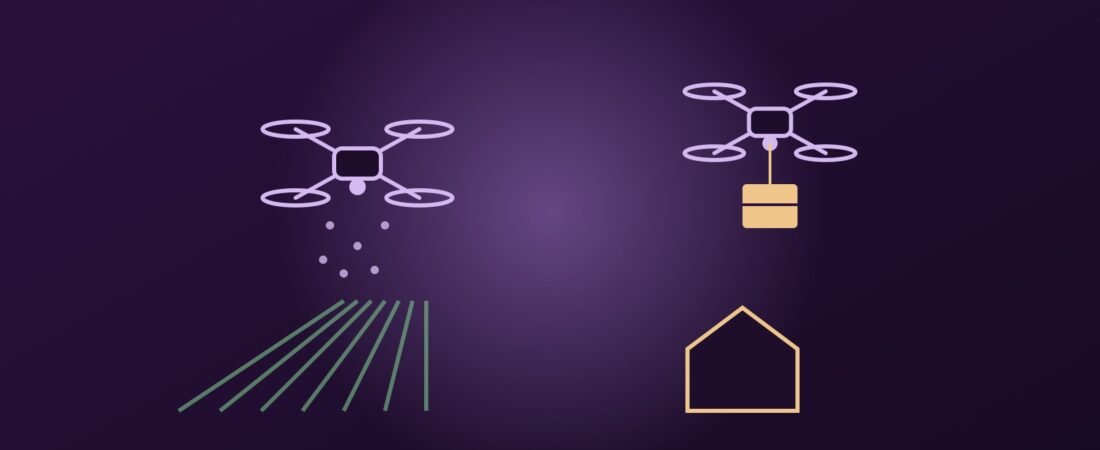
The most consequential drones in India are not those filming weddings or patrolling borders, but those quietly spraying fields, surveying land and carrying medicines to remote villages. Public policy has embraced this potential with unusual enthusiasm, treating drones not as a curiosity but as economic infrastructure capable of transforming agriculture, logistics and public services.
The Policy Toolkit
- Production linked incentives: a scheme notified in September 2021 offers incentives to domestic manufacturers of drones and drone components.
- Import restrictions: the February 2022 prohibition on imports of foreign drones, with limited exceptions, protects the nascent domestic industry.
- Kisan drones: the Union Budget for 2022 to 2023 announced support for drone use in crop assessment, digitisation of land records and spraying of insecticides and nutrients.
- Namo Drone Didi: a central scheme approved in 2023 provides drones to women’s self help groups to offer agricultural services, linking technology with rural livelihoods.
- Land mapping: the SVAMITVA scheme uses drone surveys to map rural inhabited land and issue property cards to households.
Delivery and Beyond Visual Line of Sight
Delivery is the frontier. Telangana’s Medicine from the Sky initiative of 2021 demonstrated that drones can carry vaccines and medicines to places poorly served by roads. Yet routine delivery requires operations beyond visual line of sight, in which the pilot cannot see the drone, along with reliable detect and avoid systems and a dependable framework for unmanned traffic management. The Ministry of Civil Aviation published a National Unmanned Aircraft System Traffic Management Policy Framework in October 2021, envisaging automated, software based management of low altitude airspace. Translating that vision into operational rules remains a work in progress.
The Regulatory Questions Ahead
Commercial expansion sharpens several legal questions. Who is liable when an automated delivery drone causes harm? How should airspace over private property be allocated when drones fly low and often? How will personal data captured by survey and delivery drones be governed under the Digital Personal Data Protection Act, 2023? And how can a farmer in a remote district comply with registration, certification and insurance requirements without prohibitive cost?
The Proposed Drone Law
The draft Civil Drone (Promotion and Regulation) Bill, 2025, released for consultation in September 2025, seeks to place drone regulation on a statutory footing, with mandatory registration and type certification across the supply chain, compulsory insurance and stronger penalties. Industry has warned that excessive rigidity could undo the gains of 2021. The ideal statute would retain the liberal architecture of the Drone Rules, add the accountability that a maturing industry requires, and remain flexible enough to accommodate technologies not yet invented.
Conclusion
India stands at an inflection point. Thoughtful regulation can make the country a global hub for drone manufacture and services; heavy handed regulation could ground that ambition. Law, in this field, is not merely a constraint on technology but one of the conditions of its success.
Readers seeking a fuller treatment may consult my book, Drone Laws in India: Regulation, Liability and Emerging Challenges (Allahabad Law Agency, 2026).