
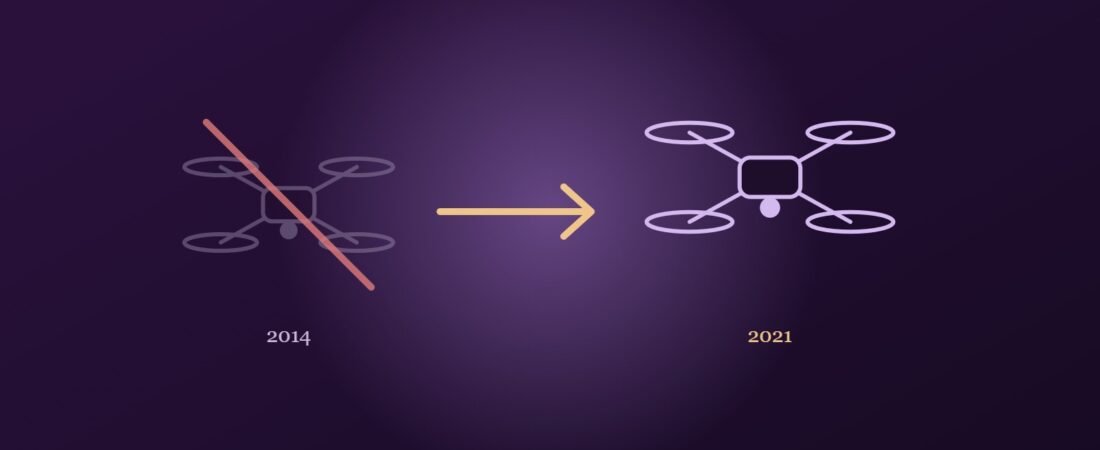
A Decade of Regulatory Reinvention
Few areas of Indian law have travelled as far, or as fast, as the regulation of unmanned aircraft. In October 2014, the Directorate General of Civil Aviation issued a public notice that effectively prohibited civilian drone operations pending a regulatory framework. For the next four years, a technology already transforming agriculture, mapping and logistics elsewhere remained, in India, largely confined to defence establishments and a grey market of unregistered hobbyists.
The First Framework: Permission Before Flight
The first comprehensive attempt came with the Civil Aviation Requirements of 2018, popularly called Drone Regulations 1.0, which took effect on 1 December 2018. They introduced the Digital Sky platform and the principle of “No Permission, No Takeoff”, under which a drone could not fly without online authorisation embedded into its firmware. The ambition was admirable, but the architecture proved cumbersome. Approvals were slow, compliance costs were high, and the Unmanned Aircraft Systems Rules, 2021 notified in March 2021 did little to relieve the burden.
The Liberal Turn of 2021
The decisive shift arrived with the Drone Rules, 2021, notified on 25 August 2021. In a striking reversal of regulatory philosophy, the government replaced a regime of prior permissions with one of trust and self certification. The number of forms fell sharply, fees were reduced to nominal levels, the requirement of security clearance before registration was removed, and an interactive airspace map divided the country into green, yellow and red zones. Nano drones and non commercial micro drones were freed from most requirements. A production linked incentive scheme followed, and in February 2022 the import of foreign drones was prohibited, with limited exceptions, to nurture domestic manufacture. The same month, an amendment abolished the remote pilot licence in favour of a remote pilot certificate.
A New Parent Statute and a Pending Bill
The Drone Rules were framed under the Aircraft Act, 1934. That colonial statute has now been repealed and replaced by the Bharatiya Vayuyan Adhiniyam, 2024, in force from 1 January 2025, under which the existing rules continue. In September 2025, the Ministry of Civil Aviation released the draft Civil Drone (Promotion and Regulation) Bill, 2025 for consultation. It proposes to replace the Drone Rules with a dedicated statute, introduce imprisonment for certain violations, and route compensation claims through Motor Accident Claims Tribunals. Industry bodies have criticised it as a retreat from liberalisation, and at the time of writing it has not been enacted.
The Enduring Question
The arc of Indian drone law reveals a persistent tension between two legitimate public interests: the promotion of an industry of immense economic promise, and the protection of security, safety and privacy. The 2021 Rules leaned decisively towards the former; the draft Bill signals a partial correction. The challenge for the legislature is to craft a statute that secures accountability without smothering innovation, and that protects citizens on the ground as carefully as it governs machines in the sky.
Readers seeking a fuller treatment may consult my book, Drone Laws in India: Regulation, Liability and Emerging Challenges (Allahabad Law Agency, 2026).